RAG // Qdrant + Llama 4
Hybrid RAG: Conversational Movie Agent
A multi-agent hybrid retrieval pipeline that answers natural-language questions across 2,200 movie screenplays — dense and sparse retrieval fused, grounded in the text.
01. The problem
LLMs confidently hallucinate about movies. A corpus of 2,200 full screenplays is far beyond any context window, and naive chunk-and-embed retrieval misses the queries that matter: exact quotes, character names, and specific scenes need keyword precision, while thematic questions (motifs, arcs, tone) need semantic search. One retrieval mode fails half the queries.
02. Architecture
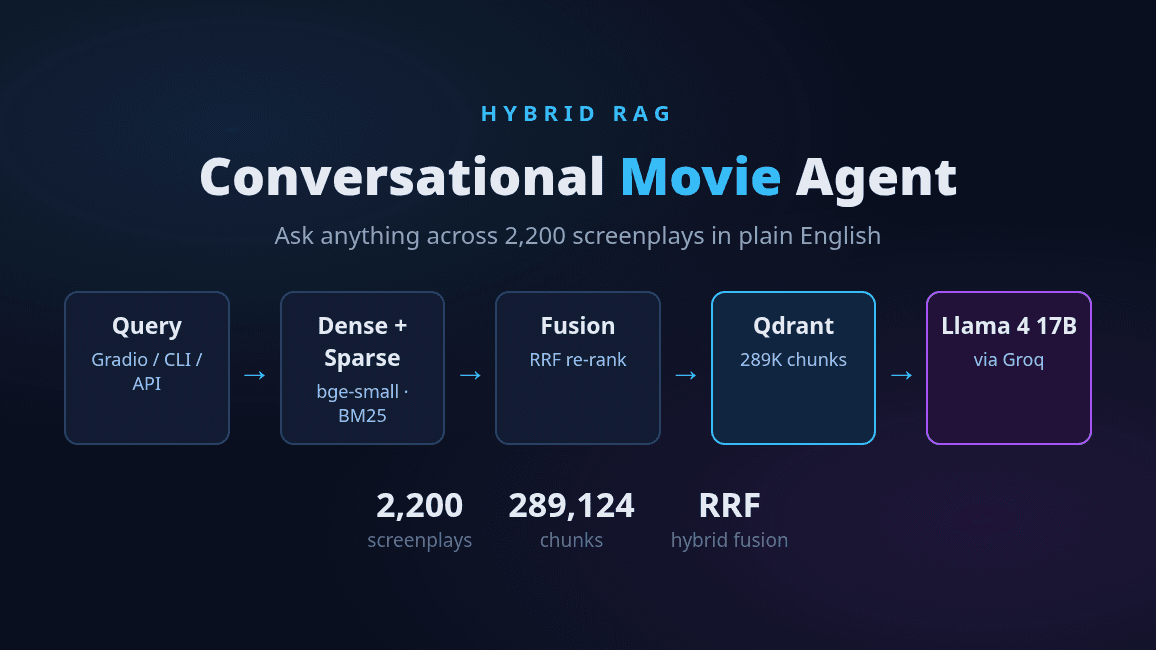
- Ingestion: 2,200 screenplays chunked into 289,124 documents, indexed in Qdrant running in a local Docker container.
- Dense path: BAAI/bge-small-en-v1.5 embeddings for semantic similarity.
- Sparse path: BM25 for exact keyword and quote matching.
- Fusion: Reciprocal Rank Fusion re-ranks both lists so a document strong in either signal surfaces.
- Serving: top-10 retrieval feeds a multi-agent setup — a default agent plus a local Gemma 4 variant — with generation on Llama 4 17B via Groq for fast inference.
- Surfaces: Gradio chat UI, CLI, and API server from one shared pipeline (cinema_rag/gradio, cli, api).
03. My approach
The key decision was refusing to choose between dense and sparse. I benchmarked the failure modes mentally first: pure embeddings bury exact quotes, pure BM25 cannot do themes — so the architecture fuses both with RRF instead of hand-tuned weights. Qdrant runs locally in Docker to keep the 289K-vector index reproducible and free, while generation goes to Groq because local inference at 17B would make a conversational demo unusably slow. Separate agents (default and local Gemma 4) behind one retrieval tool keep the experiment surface open without forking the pipeline.
04. Learnings and honest measurements
What is measured: corpus scale (2,200 scripts, 289,124 chunks), retrieval depth (k=10), and the latency rationale for Groq over local inference. What is not: I have not published a formal retrieval evaluation (recall@k, faithfulness scores) for this build, so there is no accuracy chart here — that is the documented next step, alongside query expansion and a groundedness scorer. I would rather show the gap than fill it with a synthetic benchmark.