Local AI // Python + Tauri 2 // 84 tracked issues
Heimdall: Local AI Screen Memory
Screen-only memory for Hyprland, shaped around exactly what I run. A capture daemon watches window changes, reads text, and stores everything locally — searchable, recapped nightly, nothing leaves the machine.
01. The problem
I could not remember what I did on my own computer. Cloud recall tools send pixels off-machine — unacceptable for screenshots of everything I do. And local OCR-only capture produces fuzzy, structureless text a recap cannot trust. The v2 problem statement (#20) sharpened it further: tesseract-only text was garbled, and media — YouTube, VLC, music, often the biggest part of a day — produced no pixel-derived text at all, so recaps under-sampled my actual activity and could not answer what I watched or read.
02. Architecture, three versions in
v1 (#1, locked in #11) proved the loop: event-driven capture (socket filters, debounce, keepalive for silent music stretches), frames and text in an FTS5 schema, plain-function pipes instead of LangGraph, a local Gemma 4 E2B QAT model, and opt-in self-hosted observability.
- a11y-first text routing (v2): the AT-SPI tree wins when content-bearing — 5 or more real-text nodes beyond shell chrome — and RapidOCR reads pixels only for blind windows, with a perceptual-hash change gate so its 3.8s cost lands only on new content. Tesseract retired.
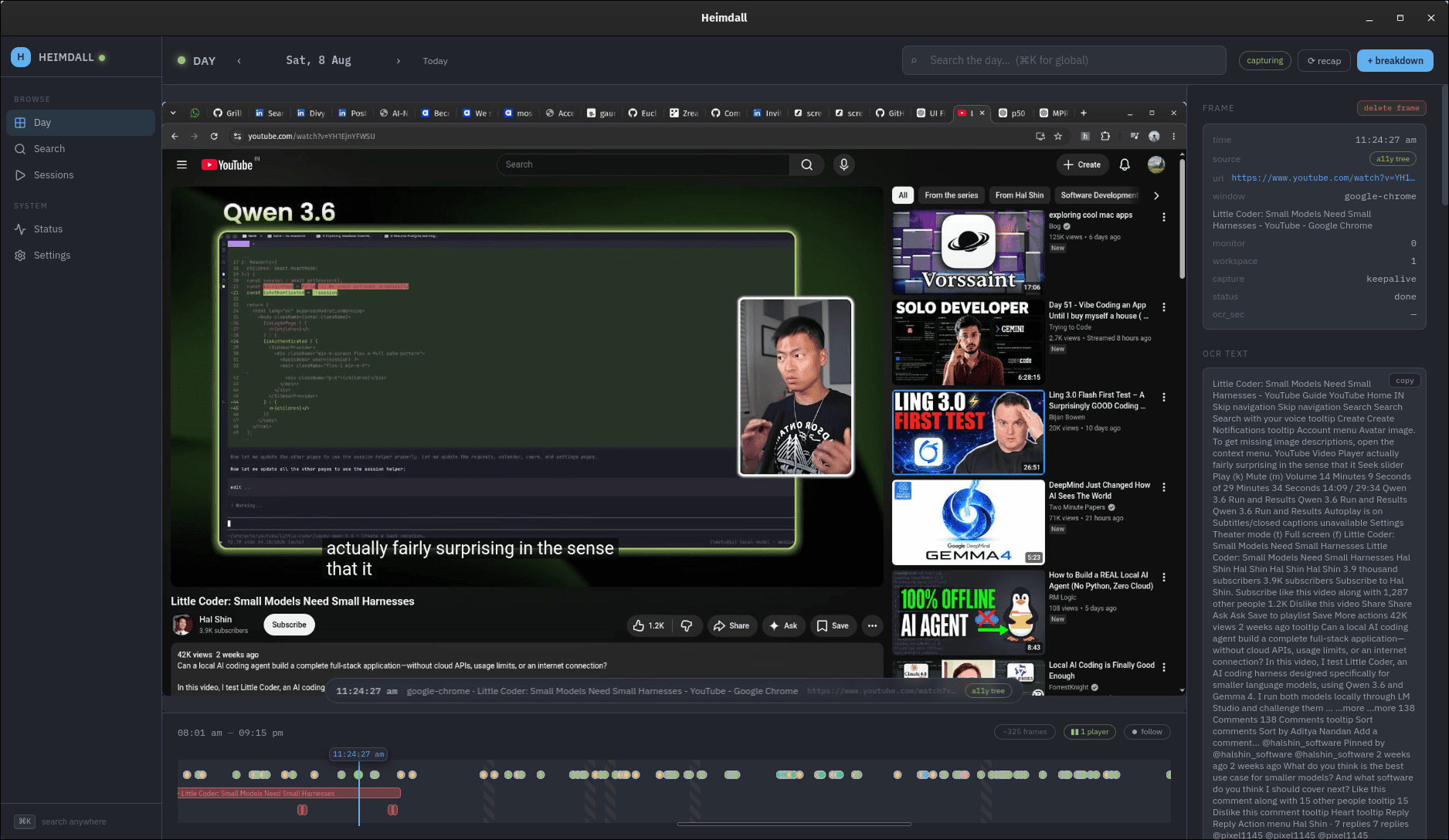
- Watch sessions as first-class memories: an MPRIS state machine over player, title, and source with microsecond positions; watched-range-only transcription, subtitles first (yt-dlp, embedded tracks), lazy faster-whisper ASR as fallback.
- CDP replaced by a native-messaging browser extension: no debug port, no Chrome approval popups on every connection.
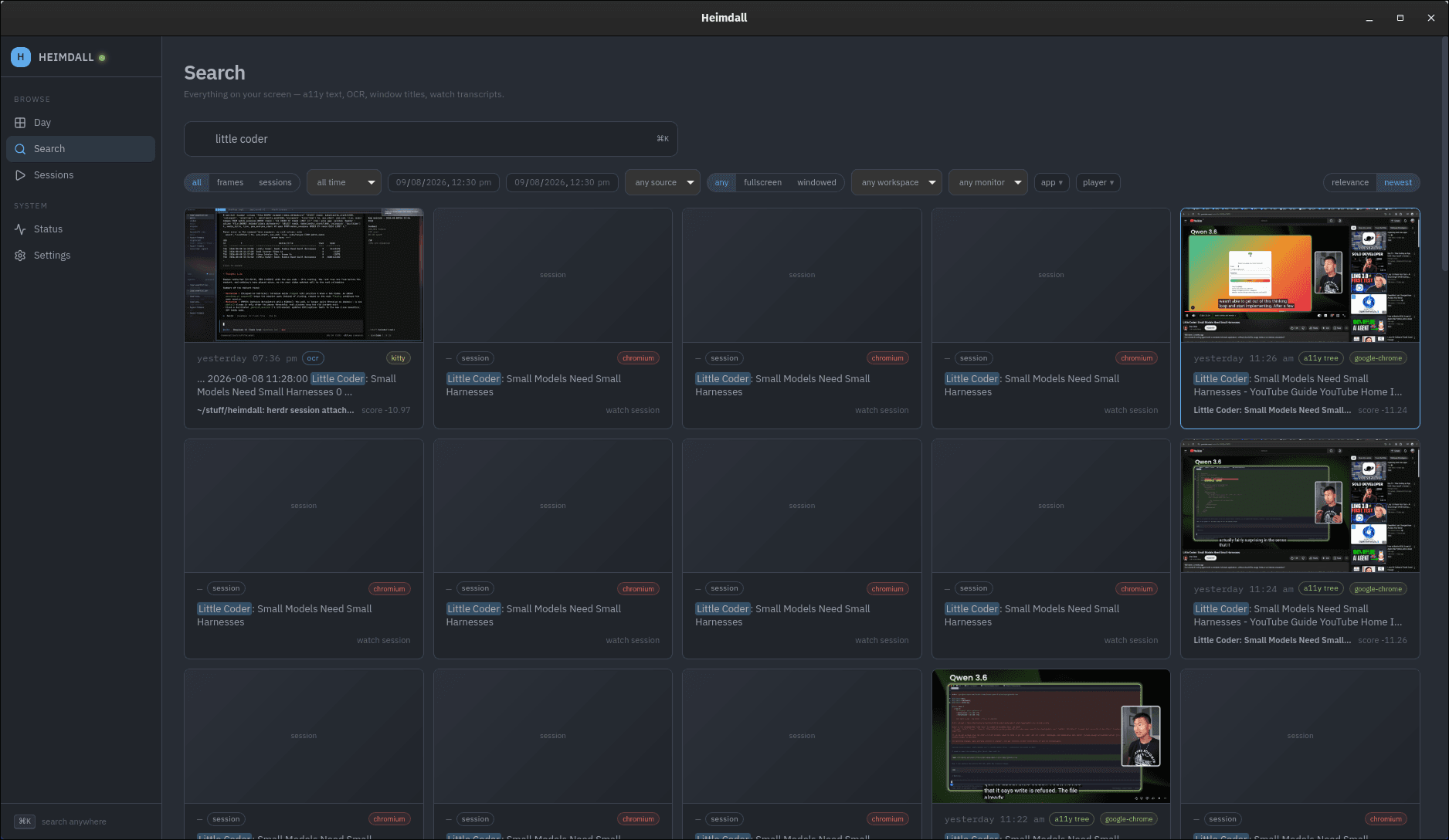
- Tauri 2 desktop client as a pure HTTP client: day timeline filmstrip, rich search with facets and a query language, sessions, status, and a settings surface.
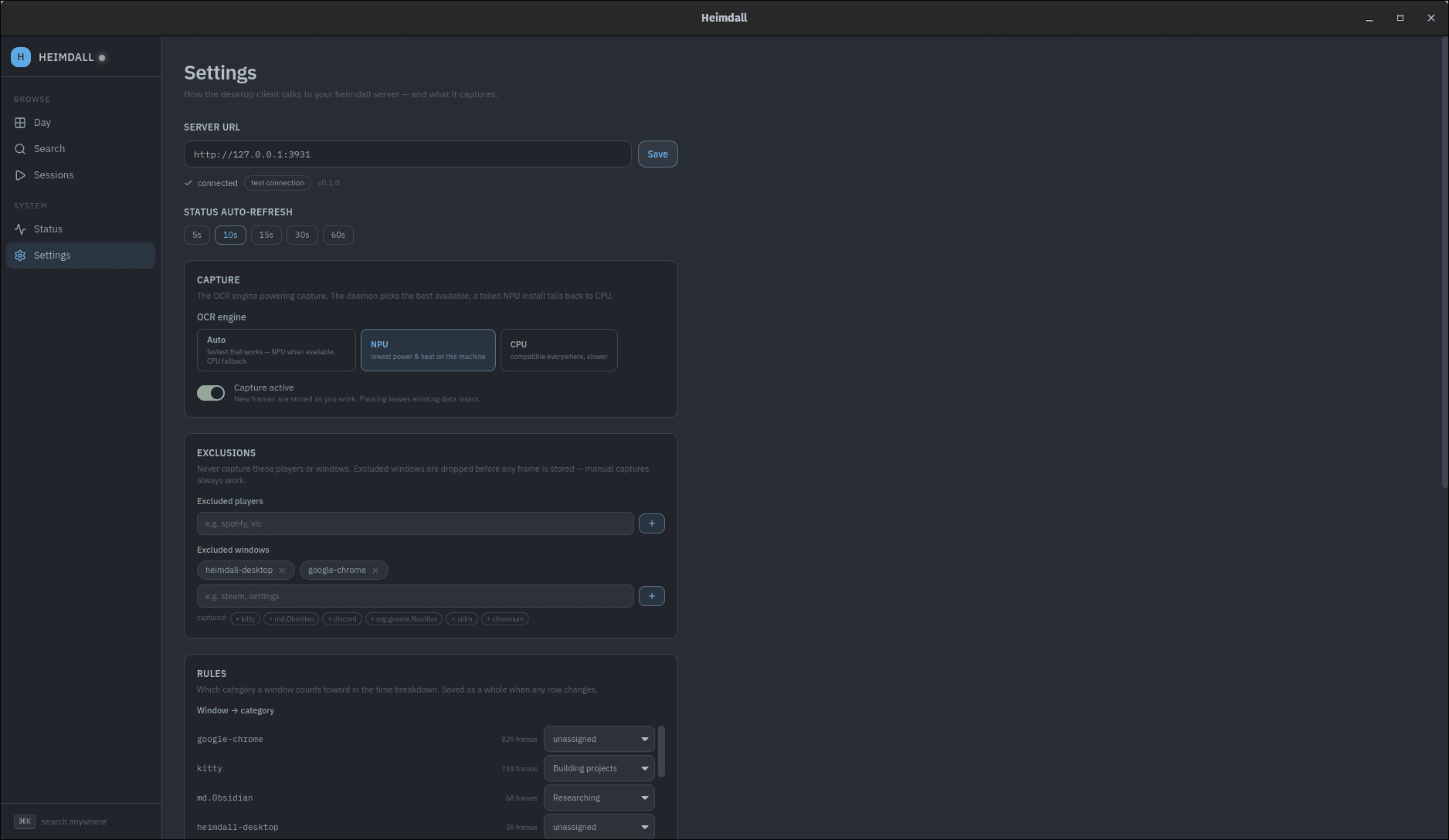
- Settings as spine: config.yaml is the single source of truth, write-through over PUT /settings, hot reload with no restart, unknown keys preserved.
- NPU OCR track: OpenVINO research, a standalone NPU-vs-CPU bench, and an open decision on making the NPU the default engine.
- v3 media map (open): rebuild the session tracker on measured per-player MPRIS fingerprints instead of the documented state machine.
03. My approach: tickets, prototypes, locked specs
Every workstream starts as a map issue that charters child tickets by type: grilling for scope decisions with me in the loop, research for background facts, throwaway prototypes for measured spikes, then implementation tasks claimed one at a time. Prototypes benchmark on a frozen 30-frame corpus under a written fairness protocol — identical ambient state, one run at a time after a parallel run crashed the machine — and I eyeball samples before anything locks. Module docstrings cite the deciding tickets, so the why is always one click away. The whole flow is visible in the public issue archive.
04. Hardest bugs
- The Chromium burst bug: background-tab Chromium throttles MPRIS to one burst per ~30s, then emits a stale position and a caught-up one that differ on title — read as a track switch, closing and reopening the session every cycle. A 26-minute video became 30+ phantom sessions of ~1s wall clock wrapping ~29s of video. Fixed by closing on mismatch only when the position is not a real-time catch-up, suspending instead of closing on zero-positions, and accruing wall time from video position.
- Music-player transition theatre: per-second lines arrive in bursts with fake Playing-to-Stopped transitions and mid-transition deregistration, closing sessions at ~0s. Fix direction is a no-compression tracker verified by a replay harness.
- Manual-capture re-fire storm: a persisted request flag made the poll loop re-capture forever — 58 frames in 29s. Fix keeps the consumed request id until a new one arrives: 1 frame instead of 58, regression-tested.
- The a11y collection gap: 763 frames a week, ~2 carrying accessibility text. The env flag alone yields 3 blind shell nodes; full 242-node trees need renderer flags in desktop overrides too.
05. Measurements
Everything below was measured on my Meteor Lake laptop — Intel Arc on Vulkan, Intel NPU via OpenVINO, Gemma 4 E2B QAT on llama-server. Your numbers will differ; that is the point of measuring on the target machine.
- Capture cadence: 1.5s debounce on window change, 10s minimum interval, 5-minute keepalive, 15s heartbeat.
- Engine costs on the frozen corpus: a11y read ~50ms and ~30MB; RapidOCR 3.8s and ~573MB; tuned tesseract 0.58 quality; OmniParser 0.54 at 95s/frame and 18.6GB; vision-LLM 0.38 at up to 98s/frame. Only the first two run at capture time.
- Gemma 4 on Arc Vulkan: 18.1 tokens/s, ~2.3GB RSS.
- Content-bearing bar: 5+ real-text nodes. Env-only Chromium exposes 3 shell nodes; env plus renderer flag exposes a 242-node tree.
- Seek rule: a position jump counts as a seek past elapsed x 2 + 30s; skipped video never counts as watched.
- Pipes run nightly — recap at 23:00, breakdown at 23:05 — over 8 fixed categories with deterministic multi-day merge, no extra LLM pass.
06. Learnings
- Measure, then lock: every routing call came from same-corpus benchmark numbers plus eyeballing, under a protocol amended only uniformly — never per-candidate.
- Fail soft at every seam: blind windows store NULL text, sessions degrade to title-only, a missing tool means no frames, never a crash.
- Position streams lie by omission: session trackers must be built on fingerprinted player behavior, not the documented state machine.
- Platform UX constraints can kill an architecture: one Chrome approval prompt per connection ended CDP polling and forced the extension.
- Serialized prototyping on shared hardware is a correctness requirement, not etiquette.